There is a moment — and most design-obsessed people can pinpoint it exactly — when a bedroom stops being a room where you sleep and becomes a room where you live. Where you eat breakfast on a Sunday. Where you read until 2am. Where you have the best conversations. Where, honestly, you spend more of your waking hours than anywhere else in the house. And nothing transforms a bedroom from functional to genuinely extraordinary quite like a headboard that refuses to be ignored.
Supersized upholstered headboards — the kind that climb toward the ceiling, the kind that wrap around the sides of the bed like an embrace, the kind that make the whole room reorganize itself around them — are having a long, sustained, deeply deserved moment. And unlike some interior design trends that peak sharply and vanish, this one has the staying power of a design movement rather than a fleeting fad.
Here's why.
The Architecture of Rest — Why Scale Changes Everything
A standard headboard does one thing: it stops your pillows sliding down the wall at midnight. Functional. Utilitarian. Forgettable.
A supersized upholstered headboard does something else entirely. It acts as architecture. It defines the entire spatial logic of a room. It creates a focal wall without a single nail hole or a single tin of paint. It introduces texture, warmth, and visual weight at the exact point where the eye naturally lands when walking through a bedroom door.
Interior designers have understood this for decades. The rest of us are catching up.
Scale, in interior design, is one of the most frequently misunderstood tools available. Most people err dramatically on the side of too small — too-small rugs, too-small art, too-small lighting fixtures — because small feels safe. It feels manageable. The fear is that going big will overwhelm the space.
In reality, the opposite is almost always true. A headboard that reaches 180cm, 200cm, even 240cm from floor to top panel doesn't shrink a room. It anchors it. It gives the eye somewhere definitive to land, which paradoxically makes the surrounding space feel more considered, more generous, more intentional.
When the headboard becomes genuinely monumental, the rest of the room breathes around it. The bedside tables become supporting cast. The pendant lights become accessories. The whole composition acquires hierarchy — that essential quality of good design where some things matter more than others, and the room communicates that clearly.
The Wrap-Around Moment — When Headboards Become Rooms Within Rooms
The wrap-around upholstered headboard is a relatively recent evolution, and it represents the single most significant development in bedroom design in the last decade.
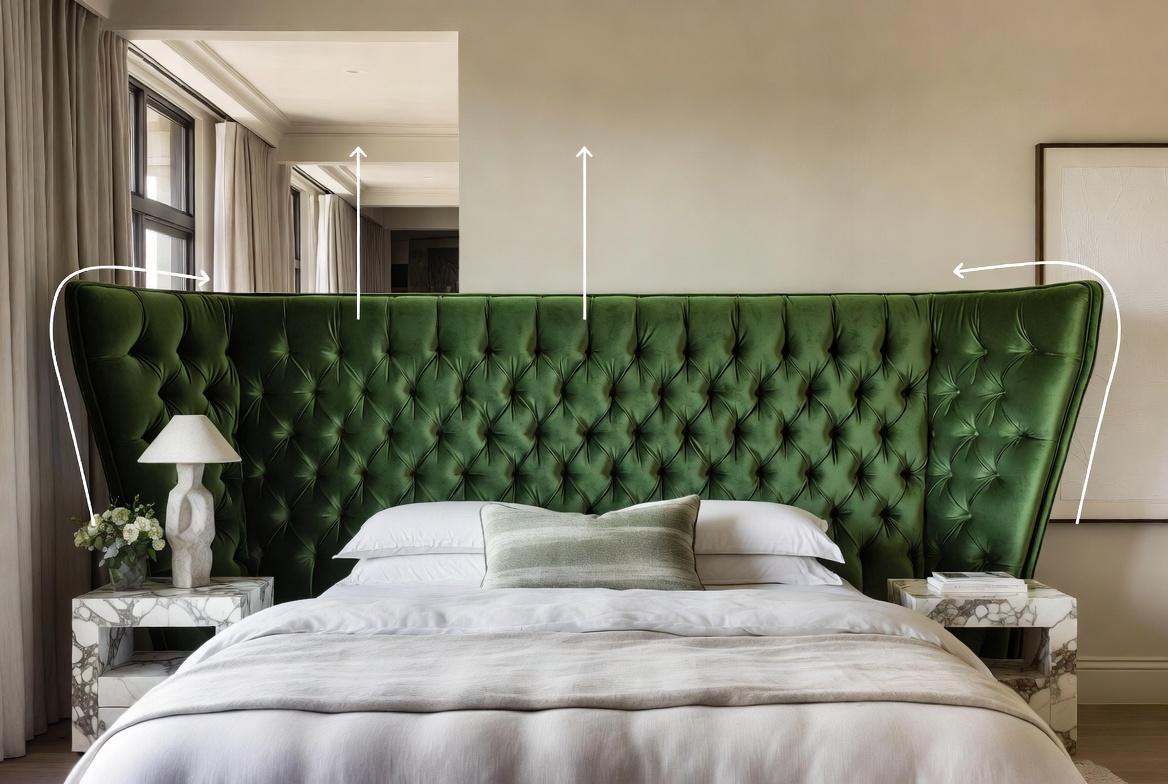
The concept is simple in theory and transformative in practice: instead of a panel that sits flat behind the bed, the headboard extends along both sides — sometimes just partially, creating padded side wings that frame the sleeping space; sometimes dramatically, running along the full length of the bed on both sides to create something that feels more like an alcove, a nook, a room within a room.
This latter version — the full wrap-around, sometimes called a peninsula headboard or a cocoon headboard — does something to a bedroom that almost no other intervention can achieve. It creates enclosure without walls. It makes the bed feel like a destination, a private world, a deliberate retreat from the rest of the house. Sleep researchers talk about the importance of the sleeping environment signalling to the brain that rest is possible; a cocoon headboard creates that signal architecturally, physically, spatially.
Practically, the wings serve multiple purposes beyond the aesthetic. They muffle sound — particularly useful in shared homes or urban apartments where noise bleeds between rooms. They provide a natural surface against which to prop pillows for reading. In houses where the bedroom layout places the bed parallel to a door, the wrap-around configuration creates a sense of enclosure that partially substitutes for a more private orientation.
But let's not pretend the practical is the point. The point is that climbing into a bed framed by upholstered panels on three sides is an entirely different sensory experience from climbing into a bed against a bare wall. It is more intimate. More dramatic. More honestly, more pleasurable.
Fabric Choices — Where the Real Decisions Live
The structure of an oversized or wrap-around headboard is the beginning. The fabric is where a headboard becomes specific to you, to your room, to the particular atmosphere you are trying to build.
Velvet remains the gold standard for oversized headboards, and the reason is straightforward: at scale, velvet does things that other fabrics cannot. Its pile catches light differently depending on angle, which means the surface of a tall velvet headboard reads as different tones at different times of day — darker and more dramatic at night, softer and warmer in morning light. Jewel tones — deep teal, plum, forest green, burnt gold — sing in velvet at this scale. Muted tones — dusty rose, sage, dove grey — acquire a depth and complexity in velvet that would be flat in a woven fabric.
Boucle is the challenger. The loopy, textured weave that has become the defining fabric of early twenty-first century interiors translates extraordinarily well to large-format headboards, particularly in cream, oat, and warm white tones. A floor-to-ceiling boucle headboard in a room with warm wood tones and stone surfaces is — there is no other word for it — serene. The texture is tactile and interesting at close range; at a distance it reads as a beautifully layered neutral that works with almost everything.
Linen and linen blends bring a different quality entirely. Where velvet is theatrical and boucle is cosy, linen is crisp and considered. A tall slim-panelled headboard in a natural linen with minimal top-stitching, in a room with precise architectural lines and a restrained palette, is the headboard for people who take their minimalism seriously. It is not flashy. It is excellent.
Leather and faux leather occupy a specific niche — particularly in headboards with deep button-tufting or bold channel quilting, where the material's firmness allows the structural lines to remain clean and defined. A floor-to-ceiling channel-quilted headboard in espresso leather in a room with dark woodwork and brass hardware is a specific kind of maximalism — one that references traditional English interiors while remaining entirely contemporary in scale.
Patterned fabrics at oversized scale demand confidence and reward it. A botanical print, a geometric jacquard, a painterly abstract — any of these, stretched across 200cm of headboard, becomes a piece of art that eliminates the need for anything else on the wall. The risk of pattern fatigue is real; this is not for the uncertain. But done well, a large-format patterned headboard is the kind of design decision that makes a room genuinely original.
The Tufting Question — Buttons, Channels, and Everything Between
Within the world of upholstered headboards, tufting is its own universe of decision-making.
Diamond tufting — the classic grid of pulled-fabric buttons creating a pattern of raised diamonds — is the heritage option. At standard headboard size it reads as traditional. At supersized scale, particularly in velvet, it reads as grandly cinematic. A 220cm diamond-tufted velvet headboard in midnight blue is a piece that could belong in a five-star hotel suite or a very confident private home, and the distinction doesn't matter.
Channel tufting — vertical channels of stitching that create a ribbed, columnar effect — is the modernist option. It is cleaner. The vertical lines extend visually upward, which makes an already-tall headboard feel taller still. In a room with low ceilings, vertical channels can work an almost architectural sleight of hand, suggesting height that isn't structurally there. In leather or faux leather, channel tufting has a kind of studied precision; in fabric, it is warmer and more relaxed.
Padded panels without tufting — smooth, generously cushioned surfaces with no stitching pattern — are having a significant moment at present. The effect is architectural rather than decorative; the headboard functions less as a piece of furniture and more as a upholstered wall section, a deliberate softening of the room's hard surfaces. This approach works particularly well in large formats and wrap-around configurations, where adding tufting detail might tip a grand composition into visual complexity. Sometimes restraint is the boldest choice.
Scalloped and arched tops have replaced the straight horizontal line as the defining silhouette of the contemporary oversized headboard. A curved top — particularly a deep single arch, or a more complex shaped cut — gives an oversized headboard a sculptural quality that is distinct from both traditional and purely architectural approaches. At 180-200cm, an arched velvet headboard reads as something that belongs in a Milanese apartment or a considered boutique hotel. It is inherently romantic without being fussy.
Color Strategy for Maximum Impact
An oversized headboard is not a detail. It is the room. Which means the colour decision is not a detail decision either.
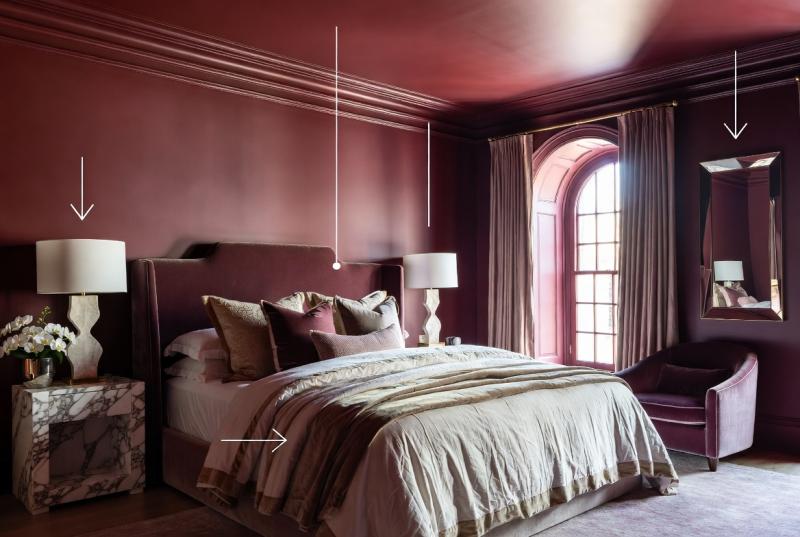
Dark and saturated colours — hunter green, ink navy, burgundy, near-black charcoal — work with specific logic at large scale. They create depth. They make the sleeping area feel more private and enclosed, which reinforces the bedroom's function as a retreat from the world. In rooms with white or light walls, a deeply coloured headboard creates a bold contrast that gives the room its entire personality. In rooms with warmer, darker walls, a similarly toned headboard creates a monochromatic immersion that feels intentional and sophisticated.
Neutral and natural tones — warm white, cream, oat, stone, warm grey — work best in boucle, linen, or textured weaves where the surface variation carries the interest. The advantage of this approach is flexibility: a stone boucle headboard works in any colour scheme, any season, with any bedlinen. It never clashes. It never dates. It simply provides warmth and texture and scale without demanding attention. For those who like to change soft furnishings frequently, this is the strategically sensible approach.
Blush, terracotta, and dusty pink continue to perform exceptionally well at large scale, particularly in rooms with warm wood floors and natural-fibre textiles. There is a specific quality to these tones — approachable, warm, slightly romantic without being saccharine — that makes oversized upholstered headboards in this palette reliably successful. They age well, too. A terracotta velvet headboard installed in 2020 does not look dated in 2026; it looks more itself.
True statement colour — cobalt blue, emerald green, mustard yellow — is for the committed. At supersized scale in a genuine statement colour, a headboard is a declaration. It announces that the person who lives here has a point of view and is not anxious about it. These headboards pair well with very restrained surrounding elements; the headboard does the work, everything else supports it.
Practical Considerations Nobody Talks About Enough
The aesthetic conversation around supersized headboards is easy. The practical conversation matters too.
Height and ceiling proportion are the first variables. A headboard that reaches floor-to-ceiling in a room with 3-metre ceilings is triumphant. The same headboard in a room with 2.2-metre ceilings is claustrophobic. The rule of thumb — not universal, but reliable — is that the headboard should leave at least 20-30cm between its top and the ceiling unless you are specifically designing for a full-height panel effect. When the gap is intentional and handled cleanly, a flush-to-ceiling headboard can work in lower rooms; when it is accidental and awkward, it looks unresolved.
Wall fixing versus freestanding is a structural question with significant implications. Floor-standing headboards — those that rest against the wall rather than attaching to it — are easier to install and easier to move, but at heights above 150cm they can feel unstable, particularly in rooms where the bed is frequently relocated or where children are involved. Wall-fixed headboards, attached via a batten system, are more permanent but more stable and typically look more intentional. For wrap-around configurations specifically, a freestanding base structure that attaches to the bed frame is common, allowing the wings to extend along the sides without requiring wall fixing at multiple points.
Cleaning and maintenance are genuinely different propositions depending on fabric choice. Velvet and boucle show pet hair, lint, and dust more readily than smooth weaves and benefit from regular brushing or a low-suction vacuum with a soft brush attachment. Leather and faux leather are the most straightforwardly wipeable option — relevant if the headboard is in a household with children or if the bed is used for eating (no judgment). Linen is the most washable, though most upholstered headboards are not designed for panel removal, so in practice most cleaning is spot-treatment.
Integration with bedside lighting changes in a wrap-around configuration. Traditional bedside table lamps work fine alongside a standard headboard; with a wrap-around that has side wings, the lamp will often sit in front of or alongside upholstered surface rather than against a wall, which means cord management and the visual relationship between the lamp and the panel both require thought. Wall-mounted swing-arm sconces, positioned above the level of the side wings, are often the cleanest solution — they clear the upholstered surface entirely and put the light source at the optimal reading angle.
Styling Around a Statement Headboard
A supersized headboard, by virtue of its scale and visual presence, sets the terms for everything else in the room. This is a feature, not a problem — but it requires some adjustment in how the surrounding space is approached.
The bedlinen question is the one most people get wrong. There is a persistent instinct to match bedlinen to the headboard, particularly when the headboard is a strong colour or pattern. Resist this. Matching creates a bedroom that looks like a product photograph rather than a room that is lived in. The more reliable approach is contrast: a bold jewel-toned headboard with crisp white linen, or a textured neutral headboard with linen in a complementary but distinct tone. The bedlinen should respond to the headboard, not repeat it.
Art on the headboard wall is, in most cases, unnecessary and often counterproductive. The headboard is the art. A large patterned headboard does not need a gallery wall above it; a tall velvet arch headboard does not need framed prints flanking it. If the wall extends above the headboard panel, a single small piece — a sculptural object, one framed work of genuine quality — can work if it is deliberate. Two or more pieces will almost always read as clutter.
Bedside tables work best when they are visually lighter than the headboard — lower in profile, simpler in form, less visually assertive. This is not a rule about matching, but a logic about visual hierarchy. If the headboard is the dominant element, everything around it should support rather than compete. Thin-legged tables, open shelves, even wall-mounted brackets in place of freestanding furniture — all of these defer to the headboard in a way that a heavy carved-wood nightstand does not.
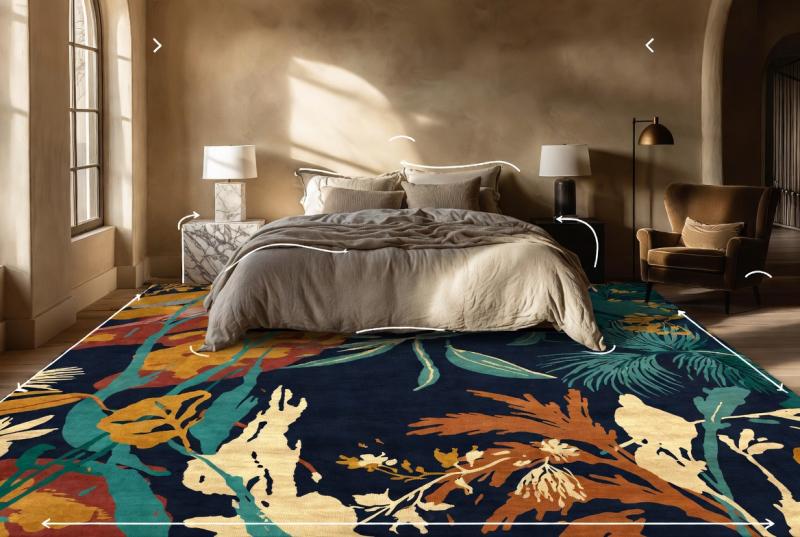
Rugs under oversized headboard configurations should almost always be large. A small rug in a room organised around a supersized headboard looks afraid of itself. The rug should extend well beyond the sides of the bed and run far enough toward the foot to anchor the entire sleeping zone. This is one of those situations where a rug that is too large is almost impossible to achieve.
The Bespoke Route — When Off-the-Shelf Falls Short
The mainstream furniture market has responded to the supersized headboard trend with enthusiasm, and there are genuinely excellent options now available at a range of price points. But the nature of oversized and wrap-around headboards — their dependence on specific room dimensions, ceiling heights, and personal specifications — means that bespoke manufacture is more commonly the right answer here than in almost any other category of bedroom furniture.
A bespoke upholstered headboard allows for precise height calibration to the room, for fabric selection from the full range of upholstery offerings rather than a curated retail subset, for tufting patterns and edge profiles specified to millimetre tolerance, and for wrap-around wing depths designed around the actual bed frame dimensions rather than averaged assumptions.
The cost differential between bespoke and off-the-shelf is real but less dramatic than it was a decade ago. As demand has grown, the number of upholstery workshops offering made-to-measure headboards at accessible price points has grown with it. The process — choosing fabric, specifying dimensions, selecting a tufting pattern — is, for most people, genuinely enjoyable. The result is, without exception, more satisfying than a standard option.
A Note on Longevity — Why This Trend Has Staying Power
Interior design trends fall into two categories. There are those that reflect a momentary aesthetic preference — the result of a particular season's collections, a specific tastemaker's influence, a cultural moment that passes. And there are those that reflect a deeper shift in how people relate to a space.
The oversized, wrap-around upholstered headboard belongs to the second category.
It reflects a sustained recalibration in how people think about the bedroom — not as the room that gets the budget and attention left over after the kitchen and living spaces are finished, but as the room that perhaps matters most. Where the day begins and ends. Where rest is attempted and, with the right environment, actually achieved. Where the quality of the surrounding space has measurable effects on the quality of the time spent in it.
It also reflects a broader return to textural richness, to materials that are soft and tactile and warm, to interiors that engage the senses rather than just the eyes. In a design landscape that spent two decades worshipping the hard, the cold, and the spare, the generous upholstered headboard is a corrective — a piece that openly, unabashedly says that comfort and beauty are not mutually exclusive, and that scale in the service of pleasure is entirely legitimate.
The bedroom is finally getting its due. And the headboard — supersized, wrap-around, upholstered in something extraordinary — is leading the way.
The most enduring interiors are built around the decisions that feel slightly too much — and then, five years later, feel exactly right.